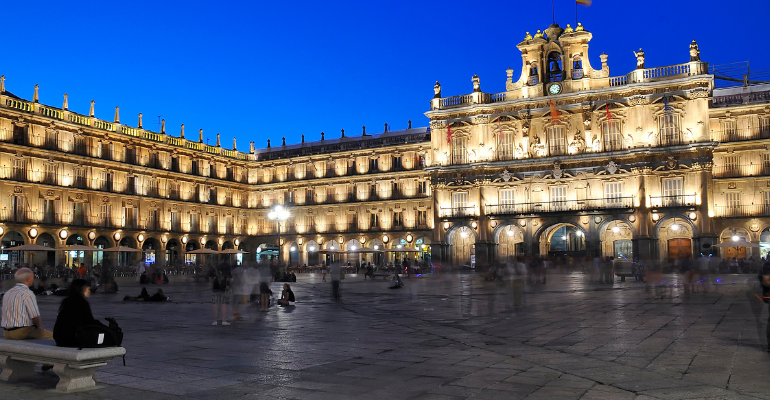
A World Icon of Urban Beauty
The Plaza Mayor of Salamanca is not simply a public space; it is the soul, the neural center, and the most sublime example of Spanish Churrigueresque Baroque. Built with Villamayor stone, which gives it its unmistakable golden color, this architectural jewel is unanimously considered one of the most beautiful squares in the world, a National Monument since 1935, and the quintessential meeting point for the social and cultural life of the charra capital.
An 18th Century Baroque Dream
The need for a central and dignified space to host the market and celebrations, including bullfights, drove its creation.
- Promoter: Its construction was driven by the corregidor (magistrate) Rodrigo Caballero y Llanes and authorized by King Philip V in the context of the beginning of the Bourbon period.
- Construction: It began in 1729, with the original design in charge of the architect Alberto de Churriguera and was concluded in 1756 by Andrés García de Quiñones, after nearly three decades of work and some interruptions.
- Original Function: Although today it is a place for outdoor cafés and strolling, in the past it was the setting for great celebrations, political proclamations, and even bullfights, accommodating almost 20,000 spectators.
Architecture and Style: Irregular Harmony
The Plaza Mayor of Salamanca is a splendid example of Spanish Baroque. It stands out for its majesty, its rich decoration, and an apparent perfection that hides a series of fascinating irregularities:
Shape: At first glance, it looks like a perfect square, but it is actually an irregular or trapezoidal quadrilateral, with none of its four facades measuring exactly the same (they vary between 75 and 82 meters).
Material: It is built with the characteristic Villamayor stone which, thanks to its composition, acquires a golden and orange tone when the light hits it, especially at sunset, creating a magical visual effect.
Structure: It is surrounded by 88 semicircular arches and has a total of 477 balconies. The four sides have their own names:
- Royal Pavilion: Oriented to the east, it was the first to be built.
- Saint Martin Pavilion: To the south, featuring medallions of military figures and conquerors.
- Pabellón de Petrineros: To the west, featuring figures of cultural personalities.
- Council Pavilion: To the north, where the City Hall stands with its imposing façade, crowned by a bell gable or belfry, which was not placed until 1852.
The Curiosities of the Plaza You Must Know
The Plaza Mayor hides secrets that enrich your visit:
- Medallions with History: The spandrels of its 88 arches are decorated with medallions portraying kings and illustrious figures in Spanish history, such as Lope de Vega, Columbus, Cervantes, or Queen Isabella II.
- The Repeated King: King Philip V’s medallion is repeated three times. This is because he was the monarch who authorized its construction and, furthermore, he reigned during two different periods (he abdicated in favor of his son Luis I and returned to the throne after his sudden death).
- Napoleonic Vandalism: In some medallions, especially in the San Martín Pavilion, mutilated noses can still be seen. A local legend attributes this damage to the vandalism committed by Napoleon’s soldiers during the War of Independence.
- Tunnels and Undergrounds: Under the arcades, there are service tunnels that, in the past, served as public restrooms and even as air-raid shelters during the Civil War. They are now sealed.
- Famous Meeting Point: The quintessential meeting point in the city is ‘under the clock’ (debajo del reloj), referring to the clock located on the bell gable of the City Hall building.
- The Mysterious Plaque: Under the arch of the Pabellón Real, next to the exit to the Market, a carved inscription can be read that says: ‘Here a woman killed herself, pray to God for her. Year 1838.’ (Aquí se mató una muger, rueguen a Dios por ella. Año de 1838). An enigma that has given rise to legends about the tragic event.
The Plaza Mayor is the incessant heartbeat of Salamanca. By day, its golden color shines under the Castilian sun, and at night, its lighting transforms it into a magical and warm setting.
Don’t hesitate: visiting the Plaza Mayor of Salamanca is immersing yourself in the history, architecture, and essence of one of the most cultured and beautiful cities in Spain.